Stop Saying "It's Just a Tool"

Whenever discussions of LLMs and society come up, it seems inevitable that the phrase "it is just a tool" is used. The argument usually goes, "LLMs are just a tool, like the word processor, or the python programming language, the ways in which we have interacted with computers are continually changing and while they have disrupted some jobs in the long term things have worked out" (or something to that effect).
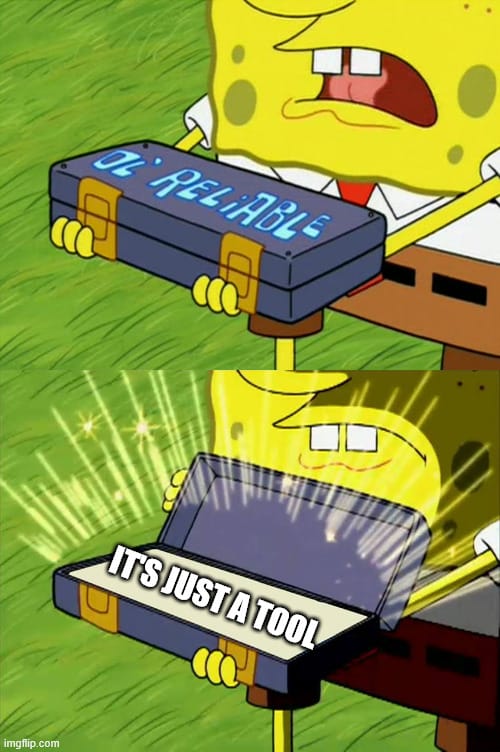
This argument is, to me, meaningless at best and incorrect at worst. Let us first discuss the former case. Yes, the argument is true, insofar as LLMs are just a tool. It's just a piece of software running on a computer, not fundamentally different from Microsoft Word or whatever the hell software Salesforce makes. But of course they are a tool, what else would be? As a general definition, a tool is merely a technology which serves as a means to end (rather than an end in itself). That means except humans (and arguably non-human animals) pretty much everything we make is a tool. A hammer, a monitor, a LLM, a UGM-133 Trident II, these are all just tools. A hammer is a tool for hitting nails, a monitor a tool for displaying digital information in high resolution, a LLM a tool for processing tokens, and a UGM-133 Trident II is a tool for killing millions of people from 7,000 miles away. And yet these objects do not all seem equal in their political and moral considerations.
This "just a tool" argument does more work than just being reductive, it also hides the political elements of the technology. It is similar to the classic refrain, "Technology is neither good nor bad, it is how you use it". As the canonical example goes, the technology to split the atom can be used for good (low carbon energy) or bad (killing people). And yet, this overlooks the political structures embedded within the deployment of nuclear energy. The fact that this neutrality view remains common is surprising given the now centuries of evidence we have seen that "first you make the tool, then the tool makes you" (as someone said). Langdon Winner's almost half century old article Do Artifacts Have Politics?showcases a number of political considerations that technologies have. In Winner's first point, technologies provide convenient means for establishing political systems of authority. He gives the example of a factory in the 1880s seeking to crush organized labor by deploying "new machines, manned by unskilled labor, actually produc[ing] inferior castings at a higher cost than the earlier process. After three years of use the machines were, in fact, abandoned, but by that time they had served their purpose - the destruction of the union." Using technology to produce a worse product, in a less efficient and more expensive manner, is already what we see with LLMs (as I argued in a previous article). You can also see it more generally with the LLM companies doing their own version of Operation Menu on Open Source Software. Anthropic acquired bun, then promptly vibe coded a rust conversion no one read and pushed it to prod (granted bun was pretty slop already). OpenAI acquired Astral (the makers of popular Python tooling such as uv and ruff ) then updated their software to raise a bunch of nothing issues to give LLMs something to fix. "If our moral and political language for evaluating technology includes only categories having to do with tools and uses, if it does not include attention to the meaning of the designs and arrangements of our artifacts, then we will blinded to much that is intellectually and practically crucial" as Winner says. Rather than merely being technologies that allow for certain forms of order, do LLMs carry with them inherently political elements? As Engels wrote of the technology of the times, "the automatic machinery of the big factory is much more despotic than the small capitalists who employ workers ever have been." Will LLMs prove to be even more despotic than the cotton spinning mill? I do not know. Perhaps LLMs carry with them no more inherent political artifacts than other Python packages, although some would argue that is unlikely. At this time I have little to say on in this direction other than, it seems like if any technology in the last decade would carry with it inherent political structures, it would be LLMs. Saying "it is just a tool" erases the very potential of having this conversation. And I'd rather have the conversations now in case LLMs introduce power relations that have extremely negative consequences for society (not that has ever happened before with Big Tech).
After writing this article I saw a similar line of argument from a Heideggerian perspective that is more fleshed out and I highly recommend reading it: https://deadsimpletech.com/blog/no-such-thing-as-just-a-tool.
Lastly, I encourage the reader to check out more of Langdon Winner's writings. He has many ideas that are prescient to our modern era, a relevant quote from The Whale and The Reactor is "We carry with us highly structured anticipations about entities that appear to participate, if only minimally, in forms of life and associated language games that are parts of human culture. Those anticipations provide much of the persuasive power of those who prematurely claim great advances in "artificial intelligence" based on narrow but impressive demonstrations of computer performance. But then children have always fantasized that their dolls were alive and talking."